
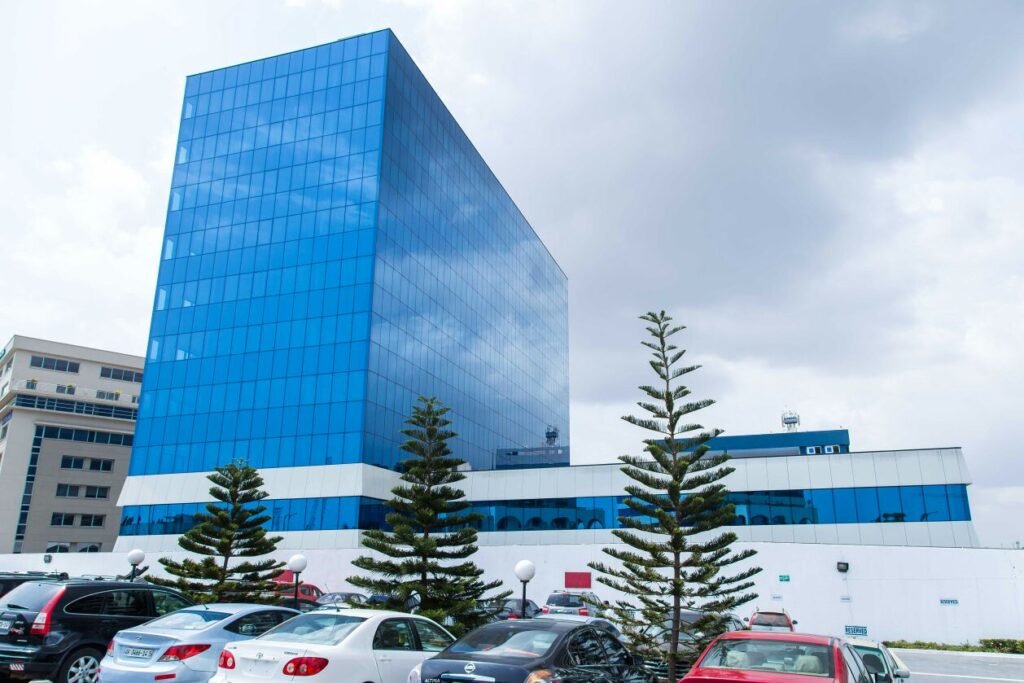
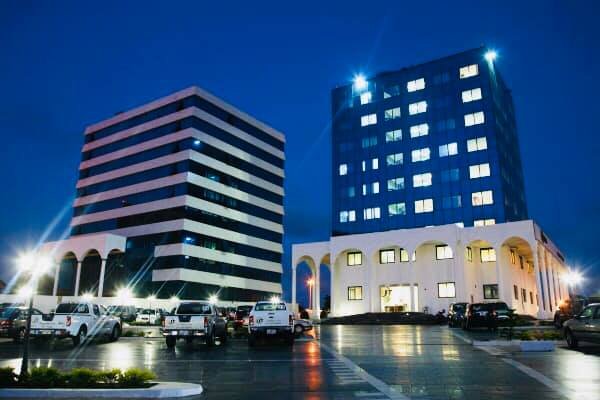
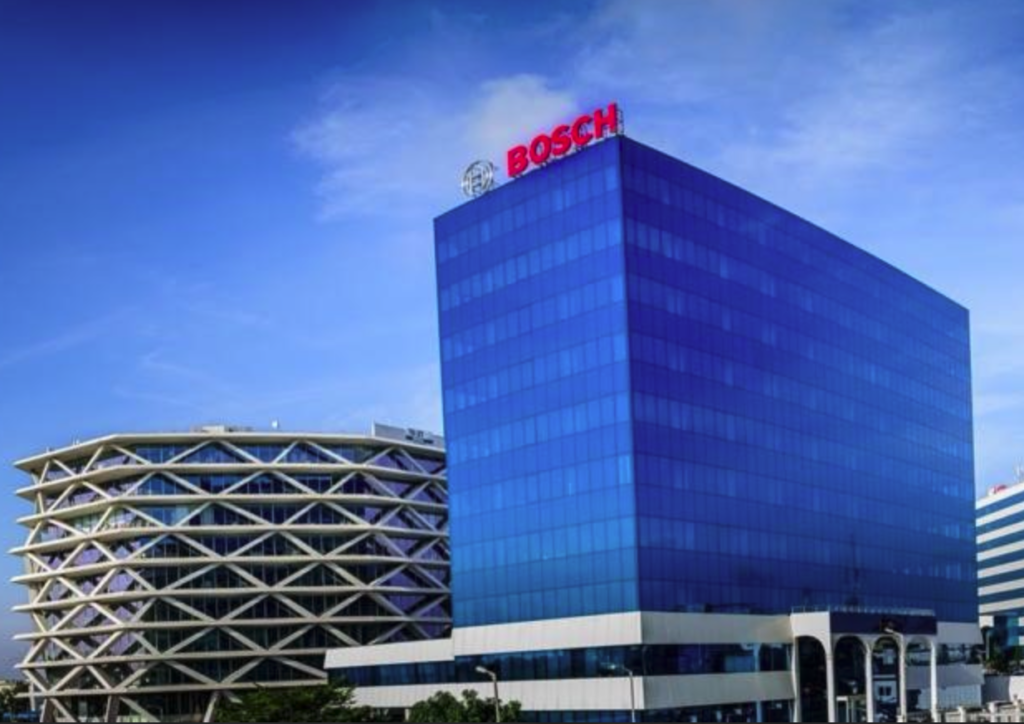
The moment most businesses regret their choice of office space for rent in Accra is rarely during the viewing stage. Usually, the building looks presentable, the location is right, and the floor plan works. The problem often reveals itself later, at 2 p.m. on a Tuesday when the power goes out, the generator takes eight minutes to kick in, and the regional director is halfway through a video call with the CFO in London.
By that point, the lease is signed.
This guide is designed for the due diligence phase before the viewing, the conversation with the landlord’s agent where many businesses ask the wrong questions or none at all. These seven infrastructure checks determine whether a building actually supports how your business operates or simply looks like it does.
Why Infrastructure Is the Most Overlooked Factor When Renting Office Space in Accra
Ghana’s commercial real estate market has matured considerably, but the gap between how buildings are presented and how they perform operationally remains wide enough to cause real problems.
A generator that exists on paper and one that runs reliably under a full building load are two different things. A building described as “fiber-ready” may simply mean fiber is available in the district, not that it is installed and running to your floor. Parking that looks adequate on a Saturday morning viewing can look very different at 8:15 a.m. on a Monday when your entire team arrives within the same 20-minute window.
These aren’t edge cases; they are daily realities for businesses that prioritized location and price without verifying the underlying infrastructure. The seven checks below are the questions serious businesses ask before committing, not after.
Check 1: Backup Power
Start here. Power interruptions in Ghana remain a commercial reality, and the difference between a building with robust backup power and one that “technically” has a generator is a difference your business will feel immediately.
What to ask, and what the answers should tell you:
Generator capacity relative to full building load: A generator that only powers the lobby and emergency lighting while leaving office floors dark is not true backup power. Ask for the generator’s rated capacity in kVA and confirm it covers operational floors under full tenant load.
Switchover time: The seconds-versus-minutes distinction matters. An eight-minute switchover means eight minutes of downtime every time the grid fails. For businesses running time-sensitive operations, that delay compounds quickly over a month.
Fuel management: Who procures fuel, who monitors levels, and what is the protocol during extended outages? A generator that is reliably serviced but periodically runs dry because no one owns the fuel-management process is not a solution.
Cost structure: Is backup power included in the service charge or billed separately? The answer affects your total occupancy cost and should be explicitly stated in the lease.
Check 2: High-Speed Fibre Internet
Internet connectivity is a daily operational dependency for virtually every business. Treat it accordingly.
“Fiber internet available” can be ambiguous. Establish whether fiber infrastructure is physically installed in the building or if it’s just a future plan. Identify which internet service providers (ISPs) have access. Determine if structured cabling is pre-run to office floors, allowing you to connect immediately, or if you will be responsible for your own last-mile installation which adds time and cost before you are operational.
For businesses running cloud-based systems, handling video calls across regional offices, or managing large data volumes, the answer to these questions isn’t a technical footnote. It determines whether your team can work normally on day one or spends the first two weeks navigating connectivity problems.
Ask to see evidence of installed fibre, not a brochure that mentions it.
Check 3: Central Air Conditioning
Accra’s climate is not forgiving, and a building’s approach to climate control affects both daily productivity and monthly operating costs in ways that aren’t always obvious at the viewing stage.
Buildings with centrally managed air conditioning systems operate more efficiently, cool more consistently, and remove maintenance responsibilities from tenants. Conversely, split-unit systems where each tenant manages their own installation and maintenance transfer both costs and administrative burdens directly to you.
Key questions include: Is the system centrally managed or tenant-managed? Is it zoned so unused areas aren’t cooled unnecessarily? Who bears the operating cost, is it included in the service charge or metered separately? Finally, what is the service and maintenance agreement, and who holds it?
A building that can’t answer these questions clearly has probably not thought carefully about how its climate control actually works for tenants at scale.
Check 4: Adequate and Secured Parking
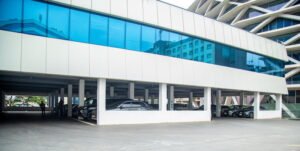
Parking is the infrastructure item most frequently underestimated during a building search and the one that generates the most persistent friction after move-in.
When evaluating office space, establish the following: How many dedicated parking spaces are allocated per floor? How is visitor parking managed (designated bays or first-come, first-served)? Is the facility covered or open-air? Is it monitored by CCTV and security staff? Is the cost included in the lease or billed separately?
For a large team, inadequate parking creates daily operational tension that affects morale, punctuality, and the client experience. This is almost impossible to resolve retroactively once a lease is signed, so get specific numbers upfront.
Check 5: Advanced Security Infrastructure
Security in a Grade A building is not a single feature. It is a layered system, and each layer matters.
CCTV coverage should extend across all common areas, entrances, exits, stairwells, and parking facilities. Access control such as key cards or biometric systems should govern entry to office floors. Security personnel should be present 24/7, and the lobby should have a structured process for visitor registration and authorization.
Security infrastructure also affects the insurability of your equipment and your compliance obligations if you handle sensitive data. A building where visitors can wander unchallenged past reception creates a security gap, regardless of what the marketing brochure says.
Check 6: Reliable Elevators
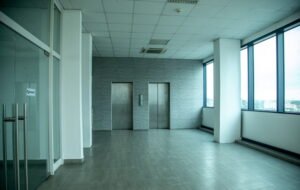
Elevators rarely come up in initial search conversations, but they are noticed every day after move-in. For a building of five floors or more, elevator reliability and capacity are critical operational variables.
The questions that matter: How many elevators serve the building relative to the total number of occupants? Is there a formal maintenance agreement with a certified service provider? What is the documented history of unplanned downtime?
A building with high occupancy and only two elevators one of which is frequently out of service creates queues and frustration. Elevator reliability is often a proxy for how seriously a building takes its overall infrastructure commitments.
Check 7: Fit-Out Ready Spaces and IT Provisions
The difference between a fit-out-ready floor and a raw shell is the difference between being operational in days or spending months managing contractors. Grade A buildings increasingly deliver floors pre-configured with raised access flooring, structured data cabling, and well-positioned power points.
Grade A buildings increasingly deliver floors that are pre-configured with raised access flooring, structured data cabling, power points positioned for open-plan or cellular layouts, and provisions for server rooms or IT infrastructure. This reduces both the capital cost of the fit-out and the lead time before your business is running.
When viewing a space, ask: What does this floor include as standard? What is the tenant’s responsibility? Does the building have server room provisions? What is the landlord’s policy on structural modifications? A prepared landlord will have clear answers; an unprepared one will tell you to “discuss it with your contractor” after you sign.
Your Pre-Signing Infrastructure Checklist
Take this to every viewing. The buildings that can answer every question clearly are the buildings worth shortlisting.
| Infrastructure Item | Key Questions to Ask |
| Backup Power | Generator capacity? Switchover time? Fuel management? Included in service charge? |
| Fibre Internet | Physically installed? Which ISPs? Pre-run cabling to floors? |
| Air Conditioning | Centrally managed or tenant-managed? Zoned? Cost structure? |
| Parking | Spaces per tenancy? Visitor bays? Covered? CCTV monitored? Included in lease? |
| Security | 24-hr CCTV? Access control on floors? Staffed 24 hours? Visitor management process? |
| Elevators | How many per total occupancy? Service contract? Downtime history? |
| Fit-Out / IT | Pre-configured? Server room provisions? Modification policy? |
Where to Find This Standard When Searching for Office Space for Rent in Accra
Not every building in Accra meets this checklist. The buildings that do tend to be concentrated in Airport City, where Grade A commercial development has set a higher infrastructure baseline than most of the city’s commercial stock.
Manet Towers is one of the Grade A developments in Airport City that delivers all seven of these infrastructure requirements as a standard built-in, not optional. Tower C is currently leasing, with floors available across a range of configurations. If you want to see what a building that passes this checklist actually looks like, a viewing is the most efficient way to find out.
Manet Tower C delivers every item on this checklist as a built-in standard. If you would like to see the infrastructure for yourself, book a viewing today.